
Sri
Gauranga
Ashram
Home
Sri Raghunath Bhatta Goswami
Om Vishnupad 108 Tridandi Swami Sri Srimat Bhakti Sravan Tirtha Goswami Maharaj ki Jai !!
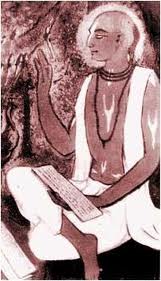 Sri Raghunath Bhatta Goswami – one of the six Goswamis of Vrindavan – is the least known among the group. No significant work of literature or discovery of deity is attributed to him.
Nontheless, he is an eternal associate of Sri Chaitanya Mahaprabhu and is identified as Sri Raga Manjari in Krishna leela.
Around 1503 AD, Raghunath Bhattacharya appeared in a Brahmin family in the village of Ramapur on the banks of the Padma River in Eastern Bengal.
Sri Raghunaha Bhatta's father's name was Sri Tapan Misra. During his pre-sanyas years, Mahaprabhu once went to East Bengal, to the Padma river, where he was a visiting professor of grammar.
There he met with Tapan Misra and made his acquaintance. Tapan Misra was considered a learned scholar in the Sastras.
One night he had a dream, and in his dream a brilliant being came before him and said, "Misra! Sri Nimai Pandita has just arrived near hear. He will teach you both the practice of perfection and the goal of life. He is not a man (nara) - he is the Supreme Lord, Nara-Narayana. Although He is the creator of the universe, he has accepted the form of a man in order to deliver the world." Saying this, the vision disappeared.
The following morning, after finishing his morning duties, Tapan Misra set out to find Sriman Mahaprabhu. Just then he saw Sri Nimai Pandita sitting on the bench before his home, His brilliant effulgence illuminating his courtyard as if the sun had descended before him.
His eyes were just like fresh lotuses, and his fine black hair was beautifully curled and flowing. His strong chest was decorated with a fine sacred thread and he wore a garment of brilliant yellow. Just as a shining moon in the midst of many stars illuminating all four directions, his effulgent form was surrounded by his disciples.
Tapan Misra offered his obeisances to the Lord, falling at his holy feet, and said, "O most merciful one! I am most fallen. Please be merciful to me." The Lord smiled affectionately, and offering him a seat, asked Tapan Misra to introduce himself.
Having introduced himself, Tapan Misra inquired from the Lord the ultimate goal of life.
Mahaprabhu said, "In every millenium the Lord advents himself in order to deliver the fallen souls and instruct them in the appropriate form of worship for each age.
In Satya-yuga, meditation, in Treta-yuga, sacrifice, in Dvapara-yuga, deity worship and in Kali-yuga, sankirtana is the process for attaining the ultimate salvation. In each of the four ages there is a particular process for deliverance. In the age of Kali, this form of dharma is nama-sankirtana."
In this way, the Lord in his form as a spiritual teacher informed Tapan Misra about the real welfare of individual souls as well as the true position of dharma in the age of Kali - that is, nama-sankirtana. He explained that apart from the holy name, nothing else will be fruitful.
He said, "In the age of Kali the sacrifice of the holy name is the essential principle. Nothing else will be effective in the age of Kali, and therefore there is no religious principle superior to this. Without the holy name there is no way to attain perfection in this age.
One should completely renounce any tendency to follow any other path and always take to the chanting of the holy name of Krishna as follows:
Hare Krishna Hare Krishna Krishna Krishna Hare Hare
Hare Rama Hare Rama Rama Rama Hare Hare.
By the influence of this mantra you will be able to understand everything about the means towards perfection and the goal of life, since there is no difference between the holy name of Krishna and Krishna Himself."
Tapan Misra, upon hearing the instructions of the Lord offered his obeisance at the Lord's feet with all his limbs prostrated upon the ground. When the Lord was about to leave for Nabadwip, he wanted to accompany the Lord on His return journey to Nabadwip.
The Lord, however, ordered him, "Soon you will go to Kashi. There we shall meet again. At that time I shall instruct you further in all these truths." Saying this, the Lord set out for Nabadwip. Soon thereafter, Tapan Misra and his wife left for Kasidham, which is also called Benares.
Some years later, out of his mercy for fallen souls, Mahaprabhu took sannyasa and went to reside in Jagannatha Puri on the order of his mother. After staying there for some months, he went through the Jharikhandaforest on his way to Vrindavan and passed through Kashi.
At the bathing ghat called Manikarnika he began chanting the holy name of Hari and exhorted everyone else to do so, saying, "Haribol! Haribol!"
Just at that time, Tapan Misra was taking bath at that very ghat. Hearing the holy name of Hari being chanted so loudly, he looked across the ghata and saw that on the banks of the bathing ghata stood a sannyasi of unprecedented beauty and stature.
His supernatural effulgence illuminated all four directions. In complete amazement, Tapan Misra thought to himself, "Who is this great personality? Could it possibly be Nimai Pandit of Nabadwip? I have heard that he has taken sannyasa. Could it be him?"
He got out of the water and looked more closely. At that time, as he looked across the water, he was certain that it was indeed Nimai Pandit. He hurried to the place where the Lord stood and offered his obeisances at the lotus feet of the Lord as joy arose within his heart. As he picked himself up from the ground, he found himself being embraced by Chaitanya Maharabhu. After so many days he had finally met the Lord again.
With great affection, Tapan Misra brought the Lord to his home. There he washed the Lord's lotus feet and then drank that holy water along with his family. His ecstasy knew no bounds. He placed his little son Raghunath at the lotus feet of the Lord and made him offer obeisance.
The Lord took the boy upon his lap and cradled him there with great affection. Meanwhile, Tapan Misra quickly made arrangements for cooking, and Balabhadra Bhattacarya, Mahaprabhu’s travelling companion, cooked the food.
He made arrangements for the Lord's bath, and when the Lord had finished bathing and performing his noon duties, the Lord ate. Tapan Misra's little son Raghunath massaged the Lord's feet, and Mahaprabhu took rest.
Hearing news of the Lord's arrival, Chandrasekhar and the Maharashtrian brahmana, as well as the other devotees came to offer their respects to the Lord's holy feet.
The Lord embraced Chandraskhar and then spoke some krishna-katha with all the devotees present. While he was in Benares, the Lord visited the temples of Visvesvara and Bindu-Madhava to take darshan.
He also visited the Dasasvamedha-ghat. The Lord stayed at the house of Chandrasekhar and dined at the house of Tapan Misra. Chandrasekhar worked as a scribe, copying scriptures for the pandits of Kashi with his own hand, in a beautiful style of calligraphy. He was from a family of highly learned brahmanas.
In Benares, wherever the Lord went, he performed kirtana. One day, the Maharashtrian brahmana submitted a request to the Lord. "O Lord," he said, " Please deliver this city of Kashi. I met with the head of the sanyasis, Prakasananda Saraswati, and three times I mentioned your name, "Krishna Chaitanya." He also uttered the word "chaitanya" three times, but he was unable to say the word "krishna" at all."
The Lord replied, "Because they are offenders at the lotus feet of Krishna, the holy name of Krishna never issues forth from their lips. The holy name and form of Krishna are no different from his very Self. They are one transcendental truth, full in ecstasy and divine reality."
Having thus instructed the devotees in various ways, the Lord set out once again to continue his long journey to Vrindavan. He would deliver Kashi with the mercy of Krishna later, on his return journey to Jagannatha Puri. And so the Lord went to Vrindavan.
After spending some time in Vrindavan wandering about in the ecstasy of krishna-prema, eventually the Lord returned to Kashi-dham. One day, he met with Prakasananda Saraswati himself.
Seeing the Lord's uncommon beauty, childlike humility, his generosity and magnanimity, Prakasananda was felt a powerful attraction. At length after a prolonged discussion on the ultimate object of all the Vedas and shastras, Prakashananda had a vision of Mahaprabhu as Krishna and he fell at the Lord's lotus feet.
After the conversion of Prakasananda Saraswati, all the sanyasis there also fell at the Lord's feet and sang his greatness, as the Lord delivered everyone there with the holy name of Krishna.
The flood of nectar flowing from the holy name soon inundated Kashi. This time the Lord spent ten days in Kashi, and the joy of his devotees and followers knew no bounds. Tapan Misra, Chandrasekhar Vaidya, and the Maharashtrian brahmana, as well as the other devotees there felt as if their life had returned, as again they had the opportunity to render personal service to Sriman Mahaprabhu.
Tapan Misra's son, Raghunath felt himself supremely fortunate to be able to serve his Lord and master, Sri Chaitanya Mahaprabhu for ten days.
At last, the time came for the Lord to bid farewell to the devotees so that he might once again set out for Jagannatha Puri. All the devotees were heartbroken in agony at the thought of separation from the Lord.
Raghunath Bhatta, the son of Tapan Misra, fell before the Lord, begging him not to go and held his lotus feet, weeping again and again. The Lord took the boy upon his lap and gave him many reassurances, trying to console him.
He said, "You must serve your father and mother here, and by and by, you may come to Puri-dhama and see me again." Then, after first embracing Tapan Misra and Chandrasekhar and instructing the devotees there in certain truths of Krishna consciousness, Sri Chaitanya Mahaprabhu bade farewell to Kashi forever, and began his long journey by foot to Jagannath Puri.
Within a short time, Sri Raghunath became expert in Sanskrit grammar, rhetoric, and poetry. Gradually, he became highly learned in the revealed scriptures. He continued to serve his mother and father into their old age, as the years passed.
When he came of age, Raghunath was ordered by his father to go to Puri to see Sri Chaitanya Maharabhu. Raghunath's ecstasy knew no bounds. In service to the Lord, Raghunath's mother had prepared various kinds of delicacies to be offered to Him by Raghunath on behalf of the Misras. All these fine delicacies had been carefully packed together in a big sack.
After receiving the blessings of his parents, Raghunath left with a servant for Puri. On the way, he met a Rama-bhakta, a devotee of Rama, who joined him in traveling to Puri. His name was Sri Rama dasa.
He was a highly learned scholar in the interpretation of that great epic, the Ramayana. Rama dasa bowed down before Raghunath and took the dust of his lotus feet. He then snatched the sack of delicacies from Raghunath's servant and began to carry it on his head.
Raghunath said, "You are a learned scholar, and what are doing?" Rama dasa said, "Bhattaji! I am the lowest of sudras. It will do me some good to serve a brahmana."
Raghunath replied, "Panditji! Please. I beg of you, let my servant carry that heavy sack." At this, Rama dasa surrendered the work of carrying the sack to Raghunatha's servant. On the way to Jagannath Puri, Raghunath dasa discussed many scriptural conclusions with Rama dasa.
Sri Raghunath Bhatta arrived in Jagannath Puri and offered his obeisances at the lotus feet of Sri Chaitanya Mahaprabhu.
danda pranama kari bhatta padila carane
prabhu raghunatha bali kaila alingane
"Raghunath Bhatta fell straight as a rod at the lotus feet of Sri Chaitanya Mahaprabhu. Then the Lord embraced him, knowing full well who he was." (Chaitanya Caritamrita Antya 13.101)
At that time the Lord, greeted him saying, "Raghunath!" He picked him up from the ground and embraced him.
Raghunath Bhatta thought to himself, "I have come to see the Lord after such a long time; He didn't know that I was coming. How is it that he is showing me so much affection? He has many devotees who are very dear to Him. Why should he show such affection for one such as myself, the lowest of devotees?"
And yet, although he considered himself very low and undeserving, when Chaitanya Mahaprabhu with a laughing, smiling, face said "Raghunath!" and embraced him, Raghunath began crying tears of ecstasy.
With tears in his eyes, he fell at the Lord's feet and, holding them, said, "O most merciful Lord. In truth, tell me, why are you giving such great consideration to this humble one?" The Lord said, "Raghunath! I cannot forget your parent's affectionate consideration for me around the time of your birth. Every day, with great affection, they used to feed me."
After this, Chaitanya Mahaprabhu introduced Raghunath Bhatta to all the devotees. All the devotees were very happy to meet him. On behalf of his parents, Raghunath gave regards and affectionate obeisances to all the devotees. He also gave them news of Chandrasekhara and all the other devotees of East Bengal.
Finally the affectionate mother of Raghunath Bhatta had sent some nice things for the Lord to eat, Bengali delicacies neatly packed in special bags. When the Lord saw them, he was very happy and ordered his servant Govinda to carefully put them away.
The Lord inquired about the welfare of Tapan Misra and his wife, and asked about Chandrasekhar as well as all the other devotees in Benares. Raghunath related all this to him and told him everything.
Sri Rama dasa was brought to the place of Mahaprabhu. Sri Rama dasa offered his obeisances to the lotus feet of Sriman Mahaprabhu, but the Lord, who is the Supersoul within all living beings, detected that Rama dasa has a desire for liberation in his heart. As a result, the Lord was not affectionate towards him.
The Lord ordered Raghunath Bhatta to go see the deity of Lord Jagannath after bathing in the ocean. Raghunath went with the other devotees to the beach, where they all took bath in the ocean and then went to see Lord Jagannath.
Afterwards, he returned to the Lord's place, and Mahaprabhu ordered his servant Govinda to give prasada to Raghunath Bhatta. The Lord took great care to see to Raghunath's food and lodgings, and there Raghunath stayed.
Raghunath would cook for the Lord on a regular basis. He stayed in Jagannath Puri for eight months in the service of the Lord and thus experienced great happiness. He witnessed for himself the ecstatic singing and dancing of Sri Gauranga in various moods of divine ecstasy before the ratha-yatra car of Lord Jagannath.
After some time, Mahaprabhu requested him to return to Kashi.
He told Raghunath to serve his aging father and mother, and explained to him that, as they were Vaishnavas, they were not to be neglected.
Raghunath Bhatta took this order of the Lord very seriously, and the Lord began to instruct him on many other points. He ordered Raghunath not to marry, and told him to study the Sastra. He told him that after some time he should again return to Jagannath Puri to see the deity of Jagannath.
With this, Mahaprabhu gave him a tulasi garland from his own neck. The Lord also gave Raghunath Bhatta some mahaprasada to be distributed among all the devotees associated with Tapan Misra and Chandrasekhara in Kashi.
When it came time to say goodbye, Raghunath Bhatta's heart ached. He fell at the lotus feet of Mahaprabhu. The Lord helped Raghunath to his feet and gave him a hearty embrace, just as before. Bidding farewell to Mahaprabhu and Jagannath Puri, Raghunath Bhatta started on his way back to Kashi.
Upon his return to Kashi, Raghunath Bhatta served his parents carefully, and began studying the Srimad-Bhagavatam in earnest. After some time his mother and father passed away.
Raghunath, adhering strictly to the orders of Sri Chaitanya, had never married. Without any family responsibilities to burden him, he went to Jagannath Puri to the lotus feet of the Lord.
When the Lord again saw Raghunath after such a long time, he was very happy. Hearing of the passing away of Tapan Misra and his devoted wife, Chaitanya Mahaprabhu spoke of their great devotion at length, and glorified them.
Raghunath Bhatta was very happy to once again have the association of the Lord. He remained in Puri and served Mahaprabhu faithfully for another eight months.
One day the Lord told him, "You must go now to Vrindavan. You have much work to do there in Vrindavan. I need to stay here in Puri, for I have been ordered by my mother to do so. As a result I cannot finish the work I have to do in Vrindavan. It is up to you to help me finish my work there."
Upon hearing these words from the Lord, Raghunath Bhatta was sorrowful at the prospect of having to leave Him again.
The Lord explained to him that in Vrindavan he would meet Rupa and Sanatana Goswami. He was to study the Srimad-Bhagavatam and related revealed scriptures under their guidance.
On the Lord's order, Raghunath Bhatta prepared to leave for Vrindavan. He bid farewell to the Vaishnavas and fell before the lotus feet of Sri Chaitanya Mahaprabhu for the last time. As Mahaprabhu was saying goodbye to Raghunath Bhatta, he gave him a long prasada garland and some tambula mahaprasada and embraced him.
Raghunath Bhatta set out on the same path to Vrindavan that once was traversed by the lotus feet of Chaitanya Mahaprabhu. In this way, as he walked along the long road to Vrindavan, Raghunath Bhatta would hear again and again of how the Lord passed on the same road. He would hear of the Lord's glories, and how he visited the different holy places and performed various wonderful activities.
When he finally arrived in Vrindavan, Rupa and Sanatana Goswami were very happy to see him and affectionately embraced him. All the Goswamis who stayed in Vrindavan with them were overjoyed to see him. They all accepted him as their affectionate godbrother.
Raghunath Bhatta was exceptionally blessed with humility and meekness. It is recorded in Chaitanya-Charitamrita that Raghunath Bhatta would recite Srimad-Bhagavatam before Rupa and Sanatana Goswami, and when doing so, he would be overwhelmed with ecstatic love for Krishna.
By the Lord's mercy he would be overcome by all the symptoms of ecstatic love of Godhead: tears, choking of the voice, and trembling. Overwhelmed in this way, he would not be able to continue the reading.
It is said that his voice was as sweet as a cuckoo's, and when reading the Bhagavata, he would sing the verses in many different tunes, or ragas. In this way, his readings were especially sweet to hear.
After some time in Vrindavan, Raghunath Bhatta arranged for his disciples to construct a temple for Govinda. He prepared various ornaments for Govinda, including a flute and shark-shaped earrings.
Raghunath Bhatta would neither hear nor discuss any gossip. He would only discuss Krishna and worship the Lord day and night. He would not listen to blasphemy of a Vaishnava, nor would he listen to talk of a Vaishnava's misbehavior.
He knew only that everyone was engaged in Krishna's service; he did not understand anything else. When Raghunath was absorbed in remembering the Lord, he would take the tulasi garland and the prasada of Jagannath given him by Mahaprabhu, bind them together and wear them on his neck.
He passed away in 1579 or 1580 A.D. His Samadhi lies in Sri Radha Kund near the samadhis of Sri Raghunath das Goswami and Sri Krishnadas Kaviraj Goswami.
Sri Sri Raghunath Bhatta Goswami Maharaj ki Jai !!
Jai Sri Radhey !
Jai Guru !